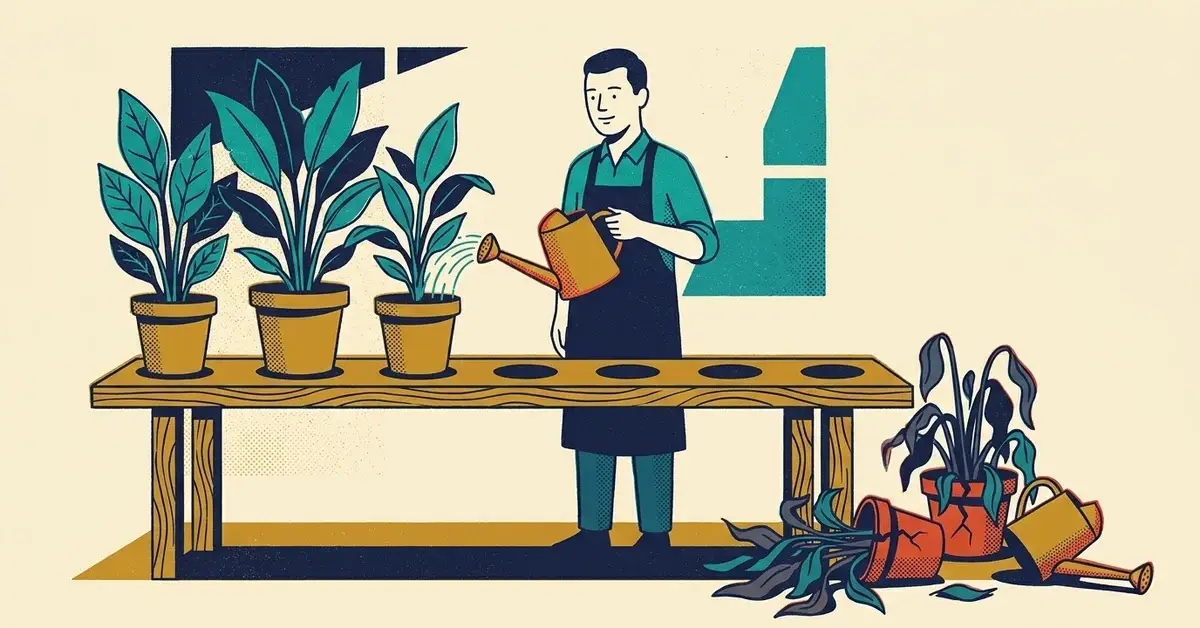
You started a daily posting streak. It lasted nine days.
Then a busy week hit, you missed a day, then three, and now the last post on your page is from a month ago. Anyone who checks you out sees a business that looks like it might have closed.
That's the real cost of "post every day." Not the time. The silence after you quit.
The quick answer
- Pick one main platform and post there 2-3 times a week. Not daily.
- Reuse those posts on one second platform, 1-2 times a week.
- Rotate three kinds of post: proof (a result), helpful (a tip), human (you, plus a next step).
- Write them all in one sitting every week or two, and schedule them.
- Spend about 10 minutes a day replying to comments and messages.
- Track conversations, not likes: clicks, calls, messages, form fills.
If you're posting zero times a week right now, start with one. Seriously.
Which situation are you in?
Be honest about where you're starting. The right schedule depends on it.
- You haven't posted in a month or more. Start at Level 1 below. The goal is proving you can show up every week.
- You post in bursts, then disappear. Your problem isn't frequency. It's writing posts on the day you publish them. Batching fixes that.
- You post regularly but nothing happens. Frequency probably isn't the issue. Look at what you post and where (the related posts at the end help).
- You post daily and you're tired. Cut to three a week and put the saved time into making those three better. You'll also stop dreading it.
The no-burnout schedule
Start with levels, not a target
Jumping from zero to four posts a week is how the streak crash happens. Climb instead:
- Level 1: 1 post a week. Just prove you can be consistent.
- Level 2: 2 posts a week (proof + helpful).
- Level 3: 3 posts a week (proof + helpful + human).
Stay at each level for 3-4 weeks before moving up. If a level starts to feel like a chore, stay there. That's your number.
A week that fits real life
Here's the three-post week I'd start most small service businesses on.
Monday: proof. Show a result. People trust receipts.
- A before and after
- A quick win from a job
- A customer review (with their OK to share it)
- "Here's what we fixed today"
Wednesday: helpful. Teach one small thing.
- A quick tip
- A short checklist
- A "most people don't realize..." warning
- One myth, one fact
Friday: human, plus a next step. Make it personal, then tell people what to do.
- Behind the scenes
- How you do the work
- Something that happened this week
- Then one line: "Want help with this? Here's how to book."
Want a fourth post? Add a Tuesday or Thursday quick hit: a photo with one sentence, a short video, or a reminder.
That's the whole plan. You don't need a seven-day masterpiece.
Stories and short video: the low-pressure extra
Stories and short clips don't need to be polished, which is exactly why they're useful. They keep you visible between real posts.
On Facebook or Instagram, I'd aim for 2-5 Stories a week: the job site, your desk, a quick poll, a one-line tip. Short video is worth doing if you can, but don't make it precious. The point is momentum.
Batch it, or it won't last
Posting by hand, on the day, is what turns social media into a daily chore.
Do this instead:
- Block 60-90 minutes every week or two.
- Write 4-8 posts in one sitting, using the proof / helpful / human rotation.
- Schedule them.
- Spend the rest of the week replying, not scrambling.
You don't need paid software to start. For Facebook and Instagram, Meta's free Business Suite can schedule posts to either or both from one screen. Meta's help page on creating and managing posts in Meta Business Suite covers it, and its Calendar guide shows how to plan a month at a glance. If you post to more platforms, our post on cheap scheduling tools compares the options.
Why posting more doesn't fix it
The fear behind daily posting is the algorithm: "If I post less, they'll stop showing me."
Platforms show people posts that get a reaction. A rushed post nobody engages with doesn't help you, however many of them you publish.
Bigger brands have been moving the same way. Sprout Social's guide on how often to post on social media says brands are posting less than they were a few years ago and calls it a shift toward quality over quantity. Those are big companies with full teams, so don't copy their numbers. Copy the direction.
So if the choice is:
- 7 rushed posts you resent, or
- 3 solid posts you can keep up
Pick the three.
If you've already gone quiet
A dead page isn't a disaster. It's a Tuesday.
- Don't apologize for the gap. Nobody noticed as much as you think.
- Post one proof post this week. A recent job is the easiest restart.
- Write the next three in one sitting and schedule them before you post the first.
- Go back to Level 1 for a few weeks, even if you used to post more.
Making it stick in a business
A schedule survives busy weeks when it isn't in one person's head.
- Put the batching session on the calendar as a recurring meeting with yourself. Same day, same time.
- Keep a running "post ideas" note that anyone on the team can add to: job photos, questions customers asked, mistakes you fixed. Our post on the five content buckets gives you a starting list.
- One team rule: take a photo at every finished job and drop it in a shared folder.
- Track what matters once a week in a simple spreadsheet:
Week | Posts published | Clicks, calls and messages | What got a reaction |
|---|---|---|---|
Week 1 | 2 | 4 | Before-and-after photo |
Week 2 | 2 | 6 | Quick-tip post |
Likes are fine. But website clicks, calls, direction requests, messages, form fills, and comments that ask a question are the ones tied to revenue. If those creep up over a couple of months, your cadence is working.
When to get help
- You've restarted three times and it keeps stalling at the same point.
- You're posting consistently but clicks, calls and messages haven't moved in three months.
- You'd rather spend the 90 minutes a fortnight on paying work.
If that's you, we can take it off your plate.
Related reading
- Never run out of post ideas: the 5 content buckets
- Posting tools that save hours: the cheap tech stack for scheduling content
- Stop posting everywhere: the 2-platform plan that wins now
Originally published January 2026. Updated November 2026.





No comments yet