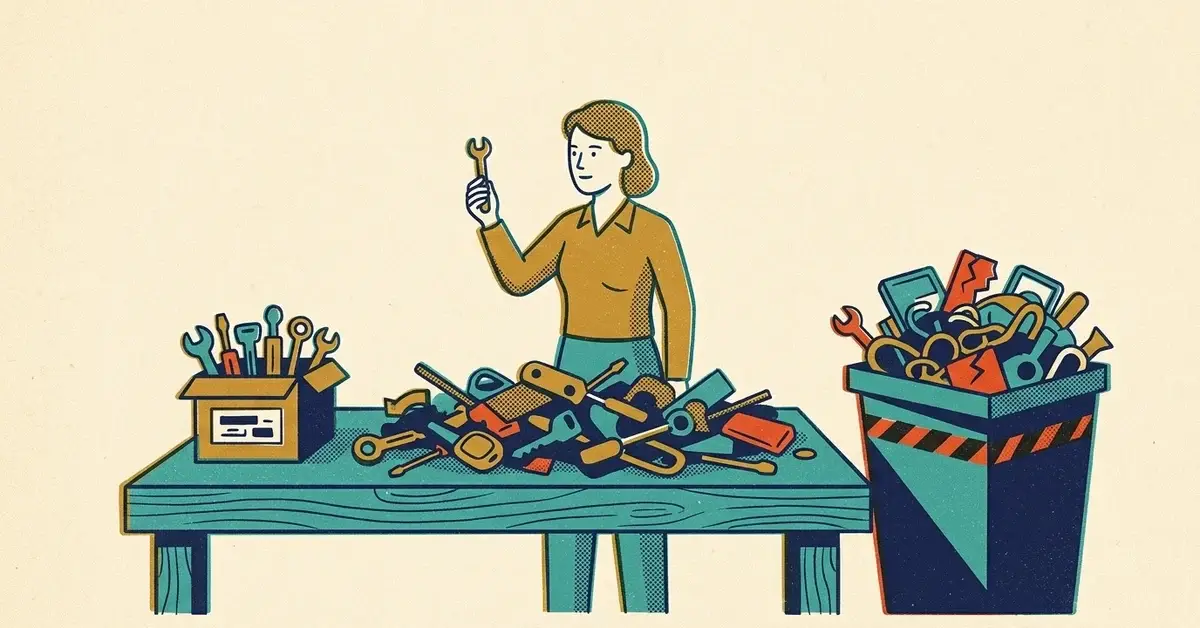
You asked ChatGPT for ways to get more repeat customers. It gave you 25. Then you asked Copilot for marketing ideas and got another 30. They all sound reasonable. Start a loyalty program. Launch a podcast. Post daily on three platforms. Host a webinar.
Now you have a long list, no time, and a nagging feeling you should be doing all of it.
You shouldn't. AI is very good at producing ideas and has no idea which ones fit your week, your budget or your customers. Picking is your job. Here's a quick way to do it, in about 30 minutes, with a simple sheet and two prompts.
The quick answer
- Ask for fewer ideas, with your limits spelled out: hours a week, budget, who does the work.
- Cut anything that fails one of three tests: it needs something you don't have, you can't say how you'd know it worked, or it would fit any business on earth.
- Score what's left on time, cost and how quickly you'd see a result.
- Ask the AI to argue against your top pick.
- Check any fact the idea depends on before you spend money on it.
- Run one idea for two weeks, with a stop date. Park the rest.
Why AI hands you so many ideas
A chat assistant predicts a likely answer to your question. "Marketing ideas for a small business" has a likely answer: the same list every article on the internet has. It doesn't know you're one person, that half your work comes from referrals, or that you hate being on camera.
And it never says "only do these two." Ask for ideas and you get a menu. A menu isn't a plan.
The fix isn't a better AI. It's a better filter, and that part is quick.
Step 1: Ask for fewer, better-fitted ideas
If you're starting fresh, don't ask for ideas at all. Ask for a short list inside your real limits:
I run a [type of business] in [town] with [number] people. Customers mostly find us through [referrals / Google / repeat business]. I can spend [hours] a week and [budget] a month on this. I don't want to [be on video / run ads / post daily]. Give me 5 ideas to [specific goal, like "get past customers to book again"]. For each: the first step I'd take this week, roughly how many hours it takes to try, and how I'd know in two weeks whether it's working.
The last part does most of the filtering for you. An idea that can't name a first step or a way to measure it usually isn't an idea yet.
If you already have a long list, paste it in and ask the AI to apply the same limits and return the five that fit best, with a one-line reason for each cut. Read the cuts too. Sometimes it throws out the one you liked, and that tells you something.
Step 2: Cut hard with three tests
Go down the list and cross out anything that fails any one of these:
- It needs something you don't have. Staff time, a skill, software, an email list, a budget. "Start a newsletter" fails if you have no list of customer emails.
- You can't say how you'd know it worked. "Build brand awareness" fails. "Five past customers book again" passes.
- It would fit any business on earth. If you swapped in a bakery or a law firm and the idea still read the same, it's generic. Keep the ones that use something specific to you: your area, your reviews, your regulars.
Most long AI lists shrink fast here. That's the point.
Step 3: Score what's left
Put the survivors in a sheet. A Google Sheet or Excel file with these columns is enough:
Column | What goes in it |
|---|---|
Idea | One line, in your own words |
Hours to try | Your honest estimate for a two-week test |
Cash to try | What you'd spend in those two weeks, or zero |
Who does it | A name, not "we" |
How we'd know | The number or sign you'd look for |
Score (1-3) | 3 = cheap, quick and clearly measurable |
Give each idea a 1, 2 or 3. Don't overthink it. You're looking for the idea that's cheap to try, quick to show a result, and that someone will actually do.
If two ideas tie, I'd pick the one aimed at customers you already have. People who know you are quicker to respond, so you find out sooner.
Step 4: Ask the AI to argue against it
Ask an AI what it thinks of your idea and you'll usually get encouragement. Ask for the opposite instead. Paste in your top idea and ask:
I'm planning to try this for two weeks: [idea]. My business is [one line]. Argue against it. What's most likely to go wrong, what am I underestimating, and what would make it a waste of time? Be specific to my situation. Don't suggest alternatives.
You're not looking for permission to quit. You're looking for the snag you'd otherwise find on day 9. If it points out something real, like "you'd need customer consent before texting them," fix that before you start, or drop to the next idea.
Step 5: Check the facts the idea rests on
Some ideas depend on a fact the AI stated with total confidence. A platform feature that exists. A rule about texting customers. What a tool costs. A "free" option that isn't.
Before you spend money or tell customers anything, check that fact on the source itself: the vendor's own help page, the platform's own pricing page, the actual rule. Not the AI's word for it. How Can I Make Sure AI Doesn't Give Me the Wrong Info? covers a quick way to do that.
Step 6: Run one idea for two weeks
- Write down the starting number (bookings from past customers this month, calls from the website, whatever you picked).
- Put the stop date in your calendar two weeks out.
- Do the work. Small and consistent beats big and abandoned.
- On the stop date, decide: keep going, adjust once, or drop it.
One at a time. Two half-done ideas tell you nothing about either.
What to do with the rest of the list
Don't delete it. Paste the leftovers into a doc called "Idea parking lot" with the date. When this test ends, you pick the next one from there, using the same sheet.
And stop generating new lists until the parking lot is empty or stale. More ideas won't help. Finished ones will.
If you've already started too many
It happens. Five half-started projects and none of them moving.
- List them all on one page.
- Run them through the three tests in Step 2, honestly.
- Keep one. Pause the others with a note on where you left off, so restarting later doesn't mean starting over.
How Can Small Businesses Use AI to Catch Decision Fatigue Before It Slows Everything Down? is worth a read if this is a pattern.
Making it a habit
- One idea in test at a time for the business. Anyone can add to the parking lot.
- Every idea gets a name, a start number and a stop date before it starts.
- AI suggests, people pick. It can draft the list and poke holes in your favorite. It doesn't decide.
If you want to turn the winners into a plan for the next few months, How Can Small Businesses Use AI to Build a Q4 Plan in an Afternoon? takes it from there.
When to get help
- The idea you picked needs your website, Google Business Profile or tracking set up properly, and you're not sure how.
- It involves connecting an AI tool to your email, customer list or bookings, and you want to know what it can see first.
- You've tested a few ideas and can't tell whether any of them worked because the numbers aren't being tracked.
If that's where you're stuck, we can help.
Related reading
- How Can Small Businesses Use AI to Build a Q4 Plan in an Afternoon?
- How Can I Make Sure AI Doesn't Give Me the Wrong Info?
- How Can Small Businesses Use AI to Catch Decision Fatigue Before It Slows Everything Down?
Originally published November 2025. Updated November 2026.




No comments yet