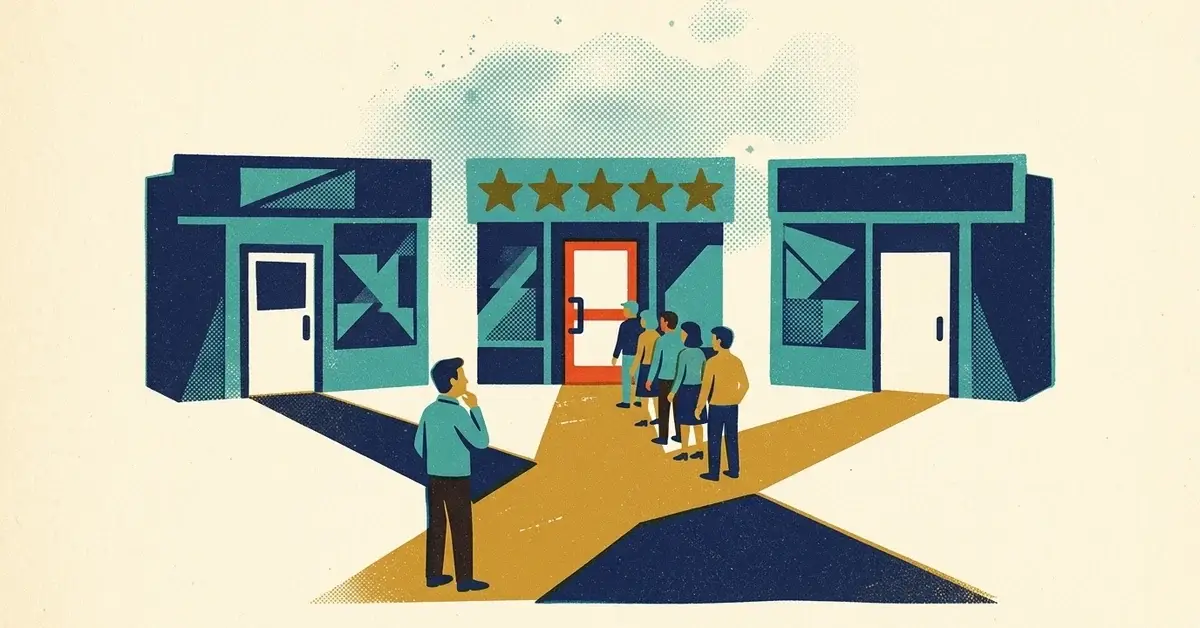
You search "plumber near me." Three businesses show up on the map.
One has dozens of reviews, a recent one from last week, and the owner replies to most of them. The other two have a handful, and the newest is from two years ago.
You already know which one gets the call. The question is whether Google is also ranking that business higher because of those reviews.
Short version: yes, partly. Google says so in writing. But reviews are one input among several, and they matter at least as much for who gets clicked as for who gets shown.
The quick answer
- Google confirms that review count and rating feed into local ranking, as part of what it calls prominence.
- Reviews don't override distance or relevance. A great rating won't put you in the map results for a town you don't serve, or a service your profile doesn't list.
- The bigger payoff is often the click: people choose between the businesses Google shows them, and reviews are the most visible difference.
- A steady flow of real reviews, with replies, beats a burst of them.
- Ask the right way. Google and the FTC both ban buying or bribing reviews.
What Google actually says about reviews and ranking
Google's help page Tips to improve your local ranking on Google names three things that decide where a Business Profile shows up:
- Relevance: how well your profile matches what someone searched for.
- Distance: how far you are from the person searching (or the place they named).
- Prominence: how well known your business is.
Reviews sit under prominence. The page says prominence is based partly on "how many websites link to your business and how many reviews you have," and that "more reviews and positive ratings can help your business's local ranking."
That's the confirmed part. It's also where the confirmed part ends.
What Google doesn't say
Plenty of SEO advice goes further than Google does. Be careful with these:
- "Keywords in reviews boost your ranking." Google doesn't say this. A review that mentions "water heater repair" does tell a reader what you did, which is useful on its own. Don't coach customers to stuff in keywords.
- "Replying to reviews is a ranking factor." Google's Tips to get more reviews page says replies show customers "that their feedback matters" and recommends replying as best practice. It doesn't call replies a ranking factor. Reply anyway, for the customers reading them.
- "You need X reviews to rank." There's no published number. You're compared with the other businesses showing up for the same search, so the useful number is theirs.
- "Stars on my website will show up in Google." Usually not. Google's review snippet guidelines say a business that controls the reviews about itself (reviews of your business, posted on your own site) is ineligible for star ratings in search results. Your Google reviews are what show stars on your profile.
Reviews do their most visible work after the search
Ranking gets you onto the shortlist. Reviews then help decide who on that shortlist gets the call.
Think about the three businesses on the map. A rating, a review count and a recent review that describes a job like yours are about the only things a searcher can compare at a glance. A profile with no recent reviews looks quiet, even if it isn't.
That's why reviews pay off even when your ranking doesn't move. If you also run ads, the same proof lowers what each lead costs you: see how reviews lower your cost per lead.
How to check where you stand (15 minutes)
Run the search your customers would run. Use the service and your town ("roof repair Springfield"), on your phone, from somewhere near your shop or service area.
Then note the top three map results and your own profile in a simple sheet. Here's the layout:
Business | Reviews | Rating | Newest review |
|---|---|---|---|
Competitor A | |||
Competitor B | |||
Competitor C | |||
You |
What to look for:
- Far fewer reviews than the top three? Volume is a gap worth closing.
- Similar count, but your newest is months old? Recency is your gap. Searchers notice it before Google does.
- More reviews than the top three, and still lower? Reviews probably aren't your problem. Check relevance (your categories and services) and distance first. Our guide to fixing a Google Business Profile that won't show on Maps covers those.
Repeat the same search once a month. It's a rough check, not a rank tracker: results shift with where you search from.
How to know if reviews are helping
Google gives you a report for this. In your Business Profile, open Performance and pick a date range (Google's guide). It shows how people found you and what they did: calls from the call button, website clicks, direction requests.
Write down those numbers before you start asking for reviews more consistently. Check again after 60 to 90 days. If reviews are working, you'd expect calls and website clicks to move, not just your position.
A review routine you can keep
Reviews help most when they arrive steadily. A burst of 30 in one week, then nothing for a year, looks odd to customers and does little for recency.
A routine that works for most small businesses:
- Ask at the moment of relief. The job is done, the problem is fixed, the customer is happy. Ask then, in person or by text the same day.
- Send the direct link. Google lets you share a review link or QR code from your profile. Our post on asking for Google reviews without breaking the rules has the exact steps and wording.
- Ask everyone, not just the happy ones. Asking only the customers you expect to be happy is called review gating, and Google's rules on rating manipulation say businesses may not "selectively solicit positive reviews from customers."
- Reply within a few days. Short and specific. Thank them, mention the job, answer anything they asked.
- Reply to the bad ones calmly. One sentence of acknowledgment, one of what you did or will do, and an offer to talk offline. Future customers read your reply more closely than the complaint.
Copy-and-paste text for step 1:
Thanks for having us out today. If we did a good job, a quick Google review really helps a small business like ours: [your review link]
What not to do
Google's Tips to get more reviews page says incentives, "like free or discounted goods or services, in exchange for customers to post reviews," are "strictly prohibited." That includes offering something to change or remove a negative review.
The FTC's rule on fake reviews and testimonials, in force since October 2024, bans fake reviews and offering a reward for a review that says something positive (or negative) (FTC announcement).
Reviews that break the rules can be removed. And if reviews start vanishing, the cause is often one of these. See why Google reviews disappear.
When to get help
- You have more and better reviews than the businesses above you, and you still don't show up.
- Reviews are disappearing, or your profile has been restricted or suspended.
- A competitor seems to be getting fake reviews, or you're getting a wave of fake bad ones.
If you'd like a second pair of eyes on your profile, get in touch.





No comments yet