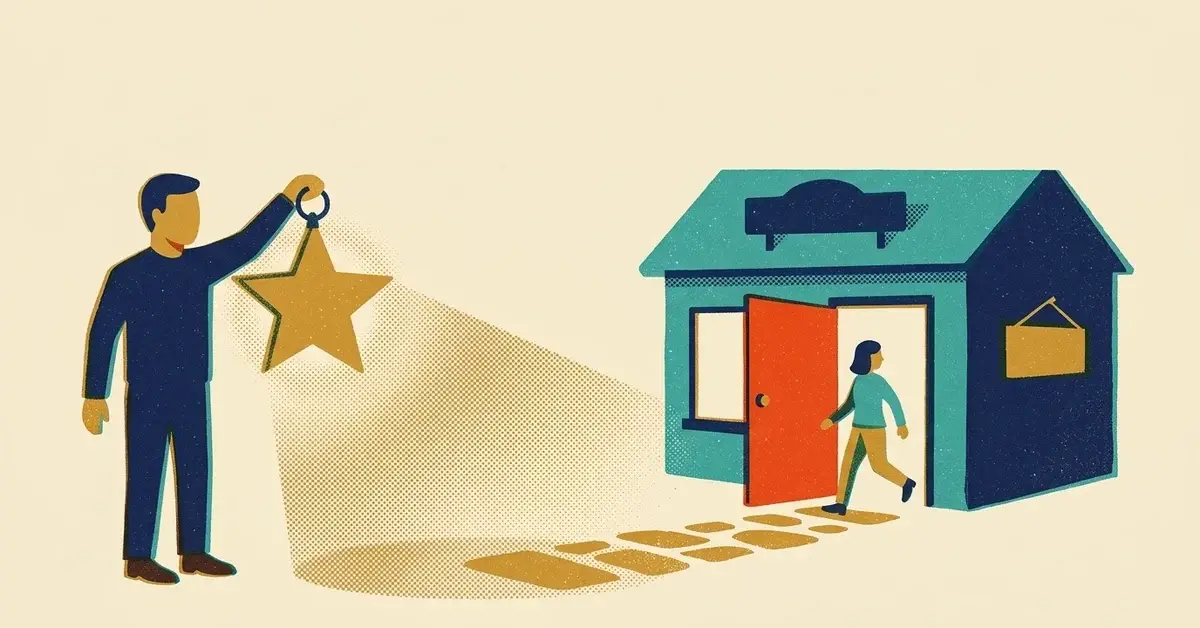
Your ads get clicks. The phone doesn't ring.
So you tweak the targeting, raise the budget, try a new platform. The cost per lead stays stubbornly high.
Often the problem isn't the ad. It's what people see after they click. They land on your page, can't tell if you're any good, and leave. You paid for that visit and got nothing.
Reviews and other proof fix that part. Which makes them part of your ad budget, not just a nice-to-have for Google.
The quick answer
- Put one short review right next to your form or call button on the page your ads send people to.
- Use a real result in your ad, not just an offer: "Leak fixed in one visit" beats "Quality plumbing services".
- Lead your retargeting ads with proof, because those people already know your name.
- Ask every customer for a review with the script below, the same way every time.
- Turn each good review into five pieces of content: an ad, a landing page block, a post, an email line and a retargeting ad.
The math: two ways to lower cost per lead
Cost per lead is what you spent on ads divided by how many leads came in. You can push it down two ways:
- Pay less per click. Better targeting, better ads, less competition.
- Turn more clicks into leads. A page that convinces more of the people who arrive.
Most people work on the first one. The second is often faster.
Say your landing page turns 2 out of every 100 visitors into a lead. Get that to 4 out of 100 and you've doubled your leads from the same spend, which halves your cost per lead. No new targeting. No new platform. Same traffic.
What moves that number is usually trust.
Why proof works after the click
Someone who clicks your ad is asking themselves a few quick questions:
- Are you a real business?
- Will you actually answer?
- Have you done this kind of job before?
- Will I get ripped off?
If the page answers those in a few seconds, they fill in the form. If it doesn't, they hit back and click the next result.
Proof answers them faster than anything you say about yourself. "We're reliable" is a claim. "Showed up on time and explained everything" from a named customer is evidence.
Where proof should show up
1. In the ad itself
The easiest place to start. Use:
- A short line from a real review, in the customer's own words
- A before-and-after photo of real work
- An outcome: what you fixed, how fast, what it saved
An ad that reads like a promotion gets treated like one. An ad that shows a result gets read.
2. On your landing page, next to the button
This is the most common miss. Testimonials sit at the bottom of the page, under the form, where nobody who's about to decide will see them.
Put proof where the decision happens:
- Right above or beside the form
- Next to the call button
- In the booking section
A simple order that works: offer, proof, button.
3. In retargeting ads
Retargeting shows ads to people who already visited your site. They know who you are. What they need now is reassurance.
Lead with:
- A review line
- A before-and-after
- A short "here's what we fixed" story (no private details)
Then follow with a helpful tip and, last, a direct offer.
The proof stack: a template you can copy
If you only do one thing from this post, build one of these and use it everywhere.
Result + review + credibility line.
- Result: one outcome. "Fixed the leak in one visit." "Same-day callback."
- Review: one sentence in the customer's own words.
- Credibility line: one true fact. The area you serve, how long you've been in business, or who you specialize in.
Example:
Leak fixed in one visit. "Showed up on time and explained everything." Family-run, serving [your town] since [year].
Use it on ads, landing pages, Google Business Profile posts and follow-up emails.
Only use claims you can back up. If "same-day" isn't true every time, don't say it.
"But we don't have many reviews yet"
Start with the proof you do have:
- Before-and-after photos
- A short quote from a happy customer, with their permission
- A short job story with private details taken out
- Photos from today's job
You can build proof while you build reviews.
A review request script that follows the rules
Most businesses either don't ask or ask awkwardly. A plain, consistent ask works better, and it keeps you inside the rules.
By text or in person, to every customer:
Hi [Name], thanks for choosing us. Would you mind leaving a quick review about how it went? One or two honest sentences really helps a small business. Here's the link: [review link]
If they're happy to, you can add:
If it's useful, mention what we worked on, so people know what to expect.
What to avoid, and why:
- Don't only ask the happy ones. Google's Maps content policy lists "selectively solicit positive reviews from customers" and discouraging negative reviews as rating manipulation. Ask everyone the same way.
- Don't offer anything for a review. The same policy bans discounts, free goods or payment in exchange for reviews.
- Don't pay for or write fake reviews, or bury the bad ones. The FTC's rule on consumer reviews and testimonials covers fake reviews, rewards tied to positive reviews and hiding negative ones (FTC questions and answers). The rule has teeth: in December 2025 the FTC sent warning letters to companies over fake reviews and rewards for 5-star reviews, and pointed out that penalties run up to $53,088 per violation (FTC business blog).
Getting your Google review link takes a minute: go to your Business Profile, select Read reviews > Get more reviews, then Copy (Google's steps). Google says the review QR code can only be made from a computer browser, not a phone.
Turn one review into five pieces of proof
A good review sitting quietly on Google is doing a fraction of its job.
When a good one comes in, turn it into:
- An ad using the review line
- A landing page proof block next to the form
- A social post with a photo from the job
- A line in your follow-up emails
- A retargeting ad
Use the customer's exact words. Don't tidy them up into something they didn't say, and ask before you use their name or photo. The FTC's guidance notes that once you feature a review in your own marketing, it's treated as a testimonial, so the same honesty rules apply.
When to get help
- Your ads get clicks but you can't tell which ones turn into calls or forms.
- Your landing page is a generic home page and you can't easily add a proof block next to the form.
- Reviews have gone missing from your Google profile and you don't know why. Start with why Google reviews disappear.
If you'd like a second pair of eyes on your ads and landing page, talk to us.
Related reading
- 5 Stars = More Traffic? Yup. Here's the Proof.
- AI for Social Proof: Turn Real Customer Feedback Into Case Studies
- SEO vs Ads: The 90-Day Plan That Stops You From Choosing Wrong
Originally published March 2026. Updated November 2026.


No comments yet