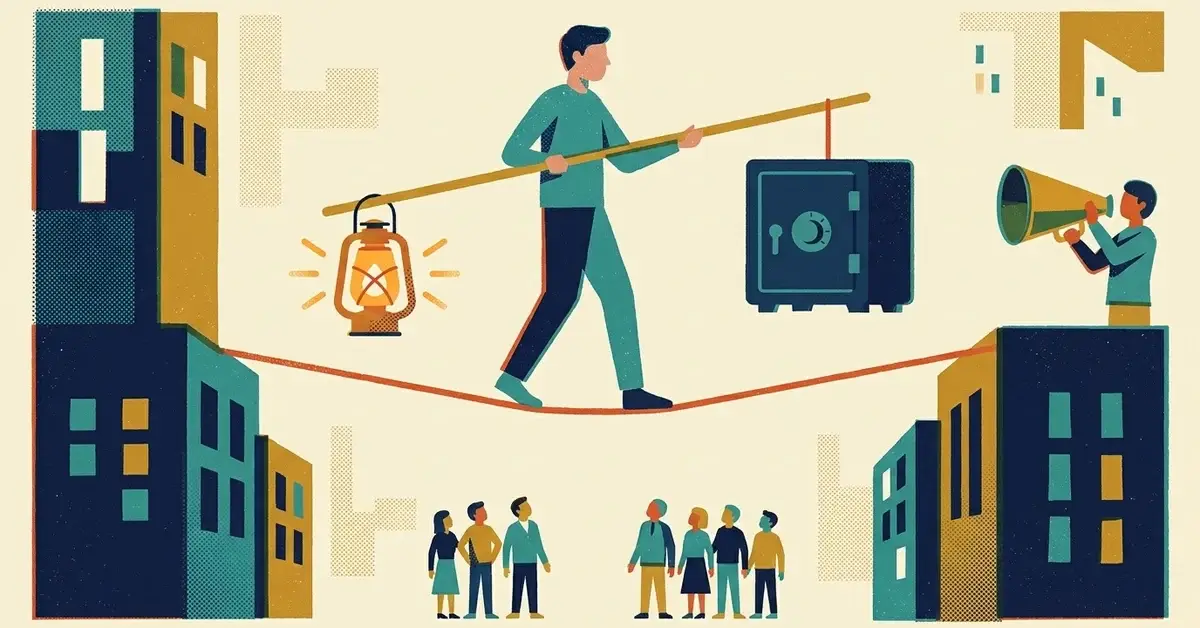
Something got breached. Maybe an email account, maybe the laptop with the client files, maybe a vendor just sent you a letter saying they were hacked and your customers' data was in it. Now you're stuck between two bad instincts: say nothing until you know everything, or tell everyone everything right now.
Neither works. Here's the deal: you owe people the truth about what affects them. You don't owe the internet the details of how the attacker got in.
The quick answer
- Stop the bleeding first. Change passwords, cut off access, and save the evidence. Don't wipe anything yet.
- Call your cyber insurer (if you have one) before you announce anything. Many policies have notice rules and a breach team they want you to use.
- Find out what data was involved and whose. That decides who you have to tell.
- Tell affected people what happened, what was involved, what you're doing and what they should do. Plain words, no guesses.
- Keep the technical details, the stolen data itself and the investigation private until the hole is closed.
What you owe people, and what you don't
This is the "ethics" part, and it's simpler than it sounds. Split everything you know into two piles.
Tell the people affected:
- That it happened, and roughly when.
- What kind of their information was involved (names, emails, card numbers, Social Security numbers).
- What you've done about it.
- What they should do now, specific to the data that was exposed.
- How to reach you with questions, and how you'll contact them later (so they can spot fake "breach update" emails).
Keep confidential:
- How the attacker got in, until it's fixed. A detailed post-mortem on day two is a how-to guide for the next attacker.
- The stolen data itself. Never re-share it, even to "prove" something.
- Anything still under investigation, especially if law enforcement asks you to hold off.
- Speculation. "We think it was probably..." is how you end up correcting yourself in public.
How to tell what kind of breach you have
Ask three questions. The answers set how much you have to say and to whom.
- Was personal information involved? Names plus Social Security numbers, driver's license numbers, financial account or card numbers, or login credentials are what most state laws care about. A defaced website with no customer data is a different problem.
- Was it encrypted? Many state laws exempt encrypted data from notice. Check whether the encryption key was taken too, because then the exemption usually doesn't apply.
- Whose data was it, and where do they live? Breach notice rules follow the state where the affected person lives, not where your office is. Every state has one. According to the National Conference of State Legislatures, all 50 states, D.C., Guam, Puerto Rico and the U.S. Virgin Islands require businesses to notify people when certain personal information is breached. Deadlines and details vary by state.
If you can't answer these yet, that's your next job. Not the announcement.
What to do, in order
1. Contain it (today)
- Change the passwords on the affected accounts and sign them out everywhere.
- Turn on multifactor authentication if it wasn't on.
- Disconnect an infected computer from the network. Don't wipe it: you may need what's on it.
- Write down what you saw and when. Screenshots are fine.
2. Make the calls
- Your cyber insurer, if you have a policy. Read the notice clause. Some require you to use their approved responders.
- A lawyer who handles data breaches, if personal information was involved. The FTC's breach response guide recommends getting legal and forensic help and checking which notification laws apply.
- Law enforcement. Report it to the FBI at ic3.gov. If they ask you to delay notice so it doesn't hurt the investigation, the FTC guide says to work out the timing with them.
- Tax preparers, CPA firms and other "financial institutions" under the FTC Safeguards Rule: if 500 or more consumers' unencrypted information was taken, you must notify the FTC within 30 days of discovering it.
3. Write the notice
The FTC's guide includes a model letter built around four headings. Here's a version you can adapt. Fill in only what you actually know.
Notice of data breach
What happened. On [date], we discovered that [an email account / a computer / a vendor we use] was accessed by someone without permission. We believe this happened between [dates].
What information was involved. [Your name and email address / your name and card number ending in XXXX]. [Information that was NOT involved, if you know it.]
What we are doing. We have [secured the account, reset passwords, brought in an outside security firm, reported it to the FBI]. [Any monitoring or support you're offering.]
What you can do. [Specific steps for this data: watch card statements, change your password on our site, place a free fraud alert.]
For more information. Call [name] at [number] or email [address]. We will only contact you about this by [method], and we will never ask for your password.
Match the steps to the data. If Social Security numbers were exposed, the FTC suggests telling people about free fraud alerts and credit freezes, and pointing them to IdentityTheft.gov. If it was an email address, that's mostly a phishing warning.
4. Tell your team what to say
One short script for anyone who answers the phone:
"Yes, we had a security incident on [date]. We've sent a letter to everyone affected with the details and what to do. I can't share more than what's in that letter, but [name] can answer questions at [number]."
Then make sure nobody posts about it on social media in a personal capacity.
Why getting this wrong backfires
A public example from 2024. After a ransomware attack on the City of Columbus, Ohio, the mayor said the leaked data was encrypted or corrupted and couldn't be used. A security researcher showed reporters it was readable personal information, and the mayor's office later acknowledged that statement was inaccurate (WOSU). The city sued the researcher to stop him sharing the data; the case was later dismissed with an injunction limiting what he could share (NBC4). The city later said data on about 500,000 people had been stolen (BleepingComputer).
Two lessons for a small business, neither of which needs a city budget. Don't play it down before you know. And don't touch or pass around stolen data, even with good intentions: that's a legal mess for everyone.
If you already said too much (or too little)
- Said something that turned out wrong? Correct it quickly and plainly: "Earlier we said X. We've since learned Y." People forgive a correction far more easily than a cover-up.
- Haven't told anyone and it's been weeks? Talk to a lawyer today. Some state deadlines are short.
- Shared technical details publicly? Make sure the hole you described is actually closed, then stop adding detail.
Preventing the scramble next time
You can't prevent every breach. You can prevent the panic.
- Know where personal data lives. A one-page list: what you collect, where it's stored, who can get to it.
- Collect less. Data you don't keep can't leak.
- Turn on MFA on email and every system with customer data.
- Save the notice template above with your insurer's and lawyer's numbers on it.
- Name one spokesperson. Everyone else uses the script.
- Check your vendors' contracts: will they tell you if they're breached, and how fast?
When to get help
- You can't tell what was accessed, or whether the attacker is still in.
- Customer financial, health or Social Security information was involved.
- You have affected customers in several states and don't know which rules apply.
That's the point to bring in people who do this every week. Talk to us if you need a hand with the technical side.


No comments yet