Your happy customers say they'd recommend you. Then nobody calls.
That's not because they didn't mean it. It's because nobody asked them at the right moment, and nobody made it easy.
Referrals are usually the best leads a small business gets. They arrive already trusting you. But most businesses treat them like luck: "If people like us, they'll tell someone." Sometimes they do. Mostly they forget.
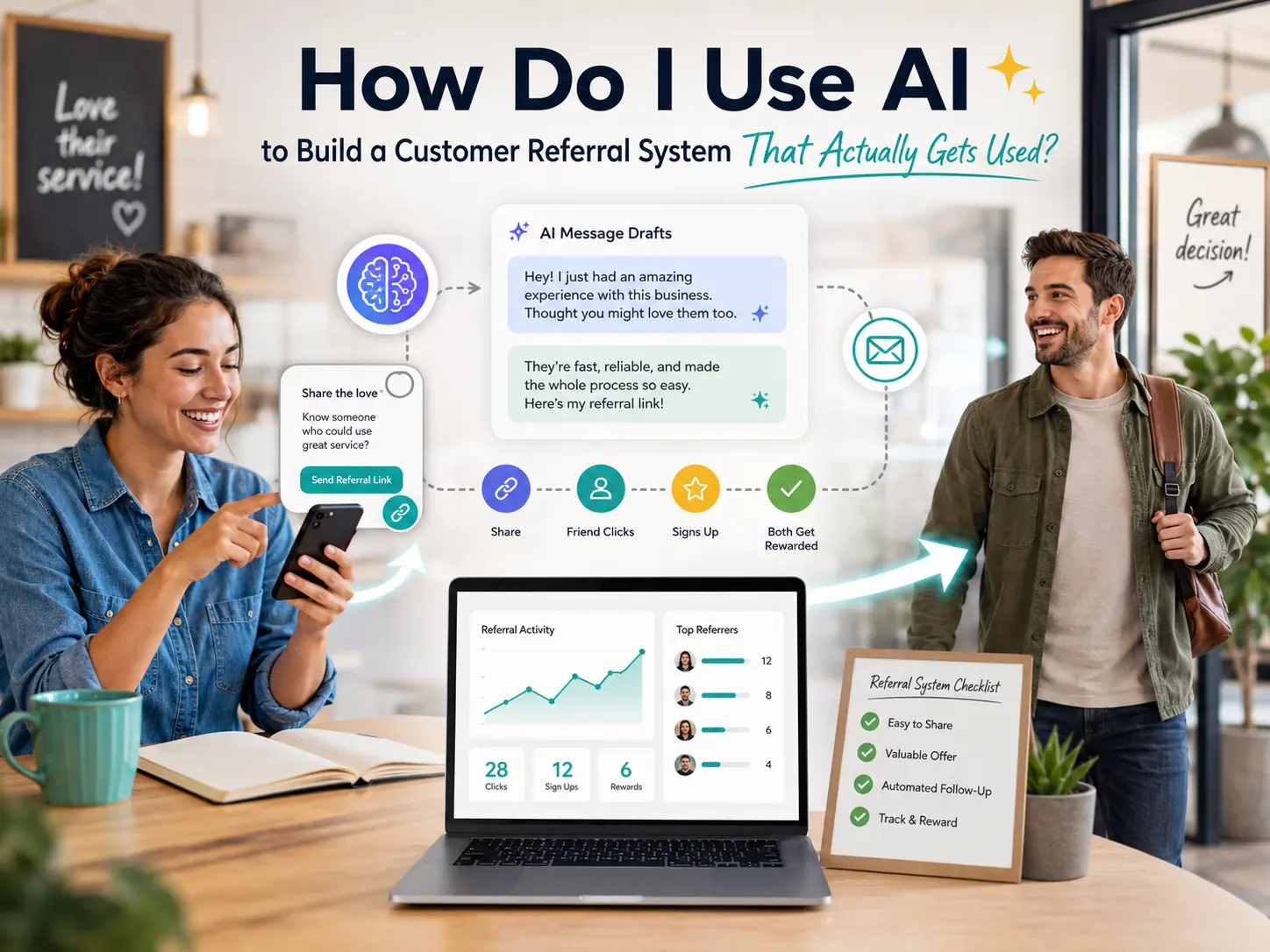
AI won't make people refer you. It's good at the parts owners avoid: writing the ask so it doesn't feel awkward, and turning "we should ask for referrals" into a step that happens every time.
The quick answer
- Pick one moment to ask, when customers are happiest (job done, invoice paid).
- Write one plain sentence that tells them what to do.
- Use AI to draft a text, an email and an in-person version of the ask.
- Give them something to forward: a short blurb, your number, your link.
- Add "send referral request" to your job closeout checklist.
- Track who referred whom, and thank every one of them.
How to tell your referrals are leaking
- You can't say who referred your last three new customers.
- You ask "when you remember", which is rarely.
- Customers say "I'll tell my friends!" and you never hear from the friends.
- Each person on your team asks differently, or not at all.
- You've never thanked anyone for a referral, because you didn't know it was one.
If that's you, the business isn't the problem. The process is missing.
Step 1: Pick one referral moment
Asking at random feels random. Pick the moment customers are most pleased and make it the standard. Common ones:
- the job is finished and they say "That looks great"
- you fixed a problem fast
- you delivered the report, estimate or result they needed
- they paid the invoice without a fuss
Pick one. Write it down.
Example rule: "Within 24 hours of closing a job the customer was happy with, we send the referral text."
Step 2: Write a one-sentence ask
No program, no portal. One sentence that says what to do:
- "If you know anyone who needs [service], feel free to give them my number."
- "If a friend's dealing with [problem], I'm happy to take a look and give them an estimate."
Rewards are optional. A gift card, a small credit or a free add-on can help. Keep two cautions in mind:
- Some licensed fields have rules about paying for referrals. In real estate and mortgage, a federal law (RESPA Section 8) bans paying for referrals of settlement services, with narrow exceptions (12 CFR 1024.14). Legal and healthcare have their own rules. If you're in one of these fields, check with your licensing board or professional association before you offer anything.
- Never tie a reward to a review. Google's review content policy prohibits reviews posted because a business offered an incentive. Keep the referral thank-you completely separate from any review request.
Step 3: Use AI to write the text, email and in-person versions
Copy and paste:
Write three referral requests for a small [type of business], friendly and not pushy: 1) a text message of two or three short sentences, 2) an email of six to eight lines, 3) a two-sentence version I can say in person. Include a thank-you, who we help, and one easy action. No hype, no guilt.
Edit what comes back so it sounds like you. Then use these as a starting point.
Text:
"Hi [Name], thanks again for choosing us. If you know anyone who needs help with [service], feel free to pass along my number. I'll take good care of them."
Email:
Subject: A quick favor
Hi [Name],
Thanks again for letting us help with [service]. If you know someone nearby who needs the same, would you be comfortable forwarding my details?
No pressure at all. Recommendations from customers like you are how most of our new work finds us.
Thanks,
[Your name]
In person:
"Thanks again, I really appreciate it. If you know anyone else who needs [service], I'd be grateful if you passed my name along."
Only send the email line about "most of our new work" if it's true for you. Otherwise cut it.
Step 4: Make it easy to pass on
If customers have to think about what to say, they won't say it. Give them a ready-made package:
- your phone number
- a link to your website's contact page
- your Google Business Profile link, so friends can see your reviews
- a two- or three-sentence blurb they can forward as is
Write a two- or three-sentence message a happy customer could forward to a friend recommending [business name]. Include what we do, the area we serve and how to reach us. Friendly, not salesy.
Something like: "I used [Business Name] for [service] and they were great. They cover [area] and made it easy. If you need help with [problem], call [phone] or go to [website]."
Step 5: Add one trigger to your closeout checklist
This is where it stops being a good intention.
Pick one trigger and make it part of the job:
- Closeout email goes out, then the referral text goes out.
- Or: invoice is paid, then the referral email goes out.
Add a line to the checklist you already use:
☐ Send referral request
Send it yourself, from the same phone or inbox you've been using with that customer. If you later move it into a texting or email tool that sends automatically, check that tool's consent and opt-out settings first. The FCC says marketing texts sent by an automated system need the person's written consent beforehand (FCC: telemarketing and robocalls).
Step 6: Track referrals with a simple sheet
If you don't track it, you can't thank people or tell what's working. A spreadsheet is plenty. Columns:
- Referred by
- New contact
- Date
- Status (contacted, quoted, booked, not a fit)
- Thank-you sent (yes or no)
Create a simple referral tracking sheet with these columns: [paste the list]. Add short instructions for checking it once a week. Keep it simple enough for a two-person team.
Look at it every Friday. Five minutes.
Step 7: Thank every referral
Most businesses ask and then forget to say thanks. The thank-you is what makes people refer you a second time.
"Hi [Name], [new customer] mentioned you sent them our way. Thank you, that means a lot."
Send it when the referral gets in touch, not only when they book.
Why referral asks feel awkward (and how to fix that)
Asking too early. If you haven't delivered yet, the ask feels like a grab. Wait for your moment.
Making it complicated. Cards, codes, forms and portals. A tiny team doesn't need any of them.
Sounding desperate. No guilt, no "it would really help us out". Make it easy and leave it there.
When to get help
- You want the closeout text and the tracker to update themselves, and your tools don't connect.
- You're moving to automated texts or emails and aren't sure what consent you need to capture.
- Referrals arrive but nobody follows up, because they land in three different inboxes.
If that sounds familiar, we can help you set it up.
Related reading
- How Do I Use AI to Create Customer Reminder Systems That Actually Get Repeat Business?
- Google Reviews Not Showing Up? The Real Reasons (And What to Do)
- Your AI "Automation" Is Ghosting Leads: The Follow-Up Gap Nobody Notices
Originally published May 2026. Updated November 2026.




No comments yet