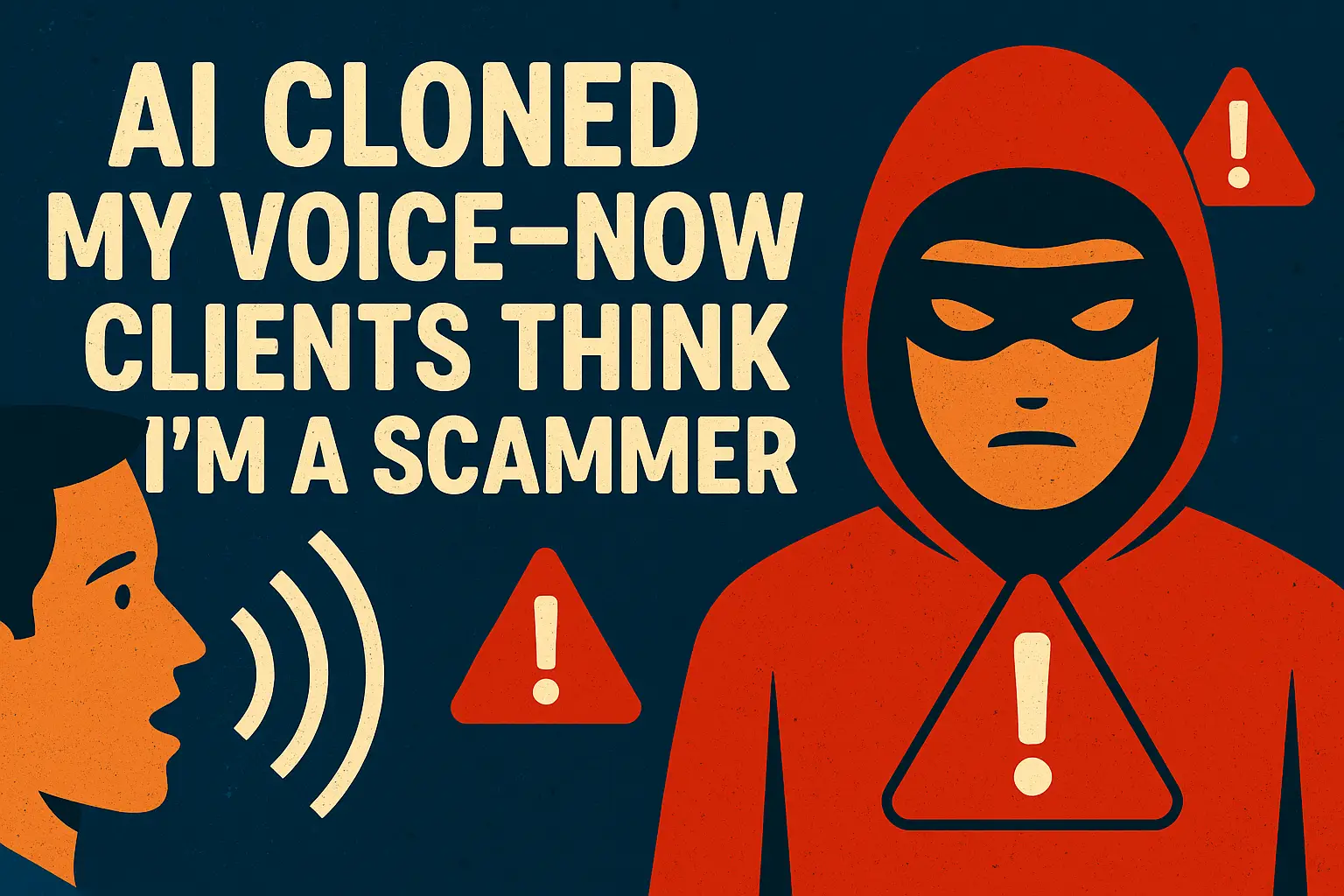
A client calls you, confused. They just got a voicemail from "you" asking them to pay an invoice to a new bank account. It sounded exactly like you. You never made that call.
Or a client stops answering, because the last "you" they heard from asked for their login and they've decided you're the scam.
Either way, someone is using a copy of your voice, and your clients are the target. Here's what to do today, and how to make it much harder next time.
The quick answer
- Warn your clients now, by email and from your real phone number: you will never ask for payment changes, passwords or gift cards by phone or voicemail.
- Give them one way to check: "If in doubt, hang up and call us on the number on our website or your contract."
- Report it to the FTC at ReportFraud.ftc.gov, and to the FBI at ic3.gov if anyone lost money.
- Set a call-back rule inside your business for anything that moves money or shares access.
- Tell your bank if the scam involved your account details or invoices.
How voice cloning works, in plain English
Voice-cloning tools learn how someone sounds from recordings of them talking, then read out whatever text they're given in that voice. Several companies sell this legitimately, for narration and accessibility. Scammers use the same kind of tool.
Where do they get your voice? Anywhere you talk in public: a podcast, a webinar, a YouTube video, a social media clip, even your voicemail greeting. A business owner who does a lot of video is easier to copy. That's not a reason to stop. It's a reason to change how money and access get confirmed.
The FBI warned in December 2024 that criminals are using generative AI, including cloned voices, to make fraud more believable (FBI public service announcement I-120324-PSA).
How to tell your voice is being used
You often find out secondhand. Watch for:
- Clients asking about calls or voicemails you didn't make, especially about payments, invoices or "updated" bank details.
- Vendors confirming a request you never sent, like a change to where you get paid.
- Staff mentioning a rushed call from you asking them to buy gift cards, send a payment or share a code.
- A client suddenly going cold or asking, "Was that really you?"
Clients and staff should look for these signs in the call itself, whatever the voice sounds like:
- Urgency. "I need this done in the next hour."
- Money or access. A payment, new bank details, a password, a verification code.
- Secrecy or a new channel. "Don't email about this, just handle it," or a call from a number they don't know.
- Resistance to a call-back. "I'm about to get on a plane."
Odd phrasing or a slightly flat voice can be a clue, but don't count on it. The voice is the part the scammer got right. The request is what gives it away.
What to do, easiest first
1. Warn your clients, plainly
Send a short email from your real address and post the same message where clients see it (your website, your Google Business Profile, social media). Something like:
We've learned that someone is impersonating our team by phone using a fake voice. We will never ask you to change payment details, pay to a new account, buy gift cards or share a password by phone or voicemail. If you get a request like that, hang up and call us on [your number], or reply to this email. Thanks for checking with us.
No drama. Clients will appreciate the heads-up, and it makes you look careful rather than compromised.
2. Publish your "how we'll contact you" rules
Put two or three lines on your invoices and in your email signature or client portal:
- "Our bank details never change by phone or email. Confirm any change by calling the number in your contract."
- "We'll never ask for your password or a security code."
Now the scam has to fight your own written rule.
3. Set a call-back rule inside your business
The same trick works on your staff. Write this down and tell everyone who can pay a bill:
Any payment, new payee, bank detail change or request for a login gets confirmed by calling back a number we already have on file. Not the number that called. Not the number in the email.
4. Agree on a code word
The FBI's December 2024 announcement suggests a secret word or phrase to confirm who you're talking to. Pick one for the owners and whoever handles money. If "the boss" calls in a hurry and can't give it, staff hang up and call back. That's not paranoia. It's a two-second check.
5. Report it
- No money lost: report the impersonation to the FTC at ReportFraud.ftc.gov.
- Money lost, or someone shared access: report it to the FBI at ic3.gov too, and call the bank right away (details below).
- Robocalls using an AI voice: the FCC ruled in February 2024 that AI-generated voices in robocalls count as "artificial" voices under the Telephone Consumer Protection Act, which made those calls illegal without prior consent (FCC). You can file a complaint at fcc.gov/complaints.
Why this works on smart people
Your clients trust your voice. That's the whole point of a relationship-based business. Scammers know that a familiar voice plus a believable reason plus a little time pressure gets people to skip the check.
Think of it like a forged signature. If the forgery is good, staring harder at it doesn't help. You call the person who supposedly signed. A client who got fooled wasn't careless. The scam was built to sound like you.
If a client has already paid or shared information
Speed matters.
- The client should call their bank's fraud line now and ask to recall or freeze the transfer, with the date, amount and receiving account ready.
- Report it at ic3.gov. The FBI asks victims to report quickly.
- If a password or code was shared, change that password and turn on two-factor authentication for the account.
- Keep everything: voicemails, call logs, emails, invoices. Don't delete the voicemail. It's evidence.
- Check your own email. If the scammer knew who your clients were and what you were invoicing them, your email account may have been accessed. Look at recent sign-ins and any new forwarding rules.
Preventing it in a business
- Written payment rules on invoices and contracts: bank details never change by phone, call-back on a known number for any change.
- Code word between owners and the people who pay bills.
- A two-minute team briefing: play an example of a cloned-voice scam and say out loud that nobody gets in trouble for checking.
- Think about your voicemail greeting. A generic greeting gives away less of your voice than a long, personal one.
- Keep your email locked down with two-factor authentication, so scammers can't read your client list and invoices.
One-line staff rule: if a call asks for money or access, hang up and call back on a number we already had.
When to get help
- A client has lost money because of a call that sounded like you.
- You suspect your email has been accessed, because the scammer knew details only your inbox would.
- You want payment rules and two-factor authentication set up across the business but don't have time.
If any of those is you, we can help.
Related reading
- Could your employees recognize your voice if it was fake?
- That's not real: how to spot AI fake emails, videos and invoices
- Is that even a real person? The rise of deepfake dangers in business
Originally published October 2025. Updated October 2026.

No comments yet